Google made AI answer links bigger and started picking who gets them
AI Mode and AI Overviews got more visible links, a section for official sites and clickable creator names. More links don't mean more clicks, and Google still won't show the clicks.
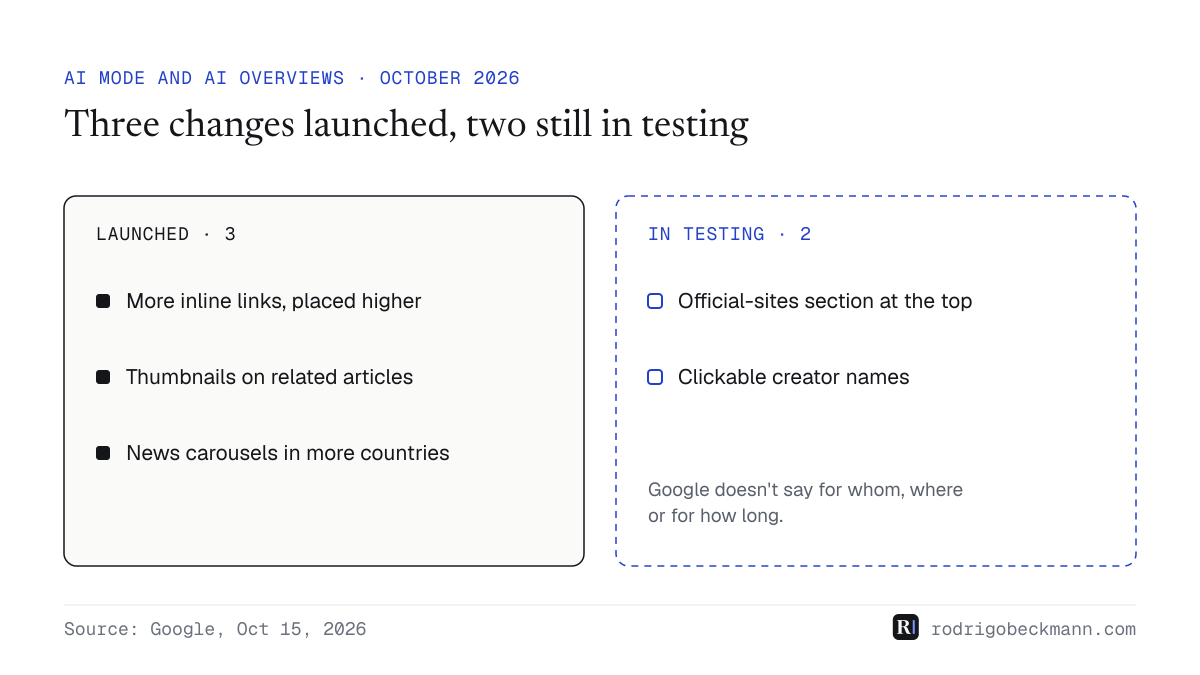
On October 15, 2026, Google announced a round of changes to links in AI Mode, Google’s conversational search mode, and in AI Overviews, the AI-generated summaries at the top of results. There are more inline links, placed higher in the response; thumbnails on related articles; news carousels in more countries; and two tests, an official-sites section at the top of the response and clickable creator names that lead to Search Profiles.
Taken as a package, it looks like Google sending traffic back to the web. The reading that matters is different: the link is shifting from a reward for position to a reward for recognition. Google is deciding, more and more explicitly, who the right source is. And it still won’t let you check how many clicks that brings.
What changed
The announcement, by Hema Budaraju, VP of Product Management for Search, covers five fronts:
- Inline links — Google cites “continued and substantial increases” in links inside AI responses, showing up higher and more often.
- Official-sites section (test) — at the top of the response, the one or two official pages for completing a task or finding exact information, with an explanation of why each link is useful.
- Related articles — links at the end of some responses (the “Dive Deeper” section) get image thumbnails and a more clickable design.
- News carousels — carousels of timely articles start rolling out to more locations and languages, highlighting the user’s Preferred Sources, the news sources users choose to see more often. According to Google, Preferred Sources usage grew more than 7x since the start of the year.
- Creators in AI Mode (test) — clickable creator and publisher names on video results, leading to the source’s Search Profile.
What’s a test and what’s left vague
Before celebrating, the limits. The two most interesting changes, the official-sites section and creator names, are tests. Google doesn’t say for whom, where, or for how long.
The carousel expansion mentions “additional locations and languages,” with no country list, so there’s no way to say whether Brazil or other specific markets are included. And none of the changes come with an impact number: there’s no data on how many clicks the new links generate.
The part the announcement doesn’t solve: clicks
In June, Search Console got a generative AI report. It shows impressions, not clicks. Barry Schwartz of Search Engine Roundtable was blunt covering the announcement: “The metric we want and find most helpful is clicks.” Google’s answer, per his report: “we’ll introduce additional metrics over time.”
So Google redesigned the response to look more clickable, but the only way to know whether it actually is more clickable is your own analytics, assuming you can isolate traffic that came from AI. More links on screen aren’t more visits to your site. Until there’s data, it’s a promise.
What this means for your strategy
Look at what the five changes have in common. Almost all of them favor a source Google already recognizes:
- the official-sites section rewards whoever is the official page for a task;
- the carousels highlight sources the user chose to follow;
- the clickable names lead to profiles only eligible sources have.
The signal is that the fight for links inside AI answers is moving from “who ranks best for this term” to “who does the system identify as the legitimate origin of this information.” For a brand, that has a practical consequence: if the answer about your product, your refund process or your policy points to a third party, the problem isn’t page-level SEO. It’s Google not recognizing you as the official source of what’s yours.
The other half is the reader. Preferred Sources growing 7x shows users are getting a say in which sources appear. An audience that chooses to follow you becomes a visibility asset inside AI, not just outside it.
What to do now
- Be unmistakably the official source for what’s yours. Clear pages for the tasks your customers look for (pricing, support, sign-up, policies), with your brand name and the exact information. That’s what the official-sites section will look for.
- Ask to be chosen. If you publish news or recurring content, treat Preferred Sources as a channel: tell readers how to add you.
- Measure it yourself. Isolate traffic from Google’s AI surfaces in your analytics and track it before and after these changes. Without click data from Google, your measurement is the only one there is.
Keep in mind that all of this is Google’s AI only. ChatGPT, Perplexity and Gemini pick and display sources by their own rules, and none of these changes affect what happens there.
What sticks
Google isn’t just putting more links in AI answers. It’s choosing, more deliberately, who they point to. Sources that are recognized as official, followed and identifiable get the link. Whether they get the click, nobody outside Google can tell yet.
Frequently asked questions
What changed in AI Mode and AI Overviews links in October 2026?
On October 15, 2026, Google announced it will show more inline links in AI responses, placed higher in the response more often. Related article links at the end of some responses got image thumbnails and a more clickable design. Carousels of timely news articles started rolling out to more countries and languages, highlighting the user's Preferred Sources.
What is the new official-sites section at the top of Google's AI responses?
It's a Google test: a section at the top of an AI response that highlights the one or two official pages for completing a specific task or finding exact information, with an explanation of why each link is useful. For now it's a test, not a general launch.
Does Google show how many clicks sites get from AI Mode and AI Overviews?
No. The Search Console generative AI report, launched in June 2026, shows impressions, not clicks. According to Search Engine Roundtable, Google answered the request for click data by saying it will introduce additional metrics over time, with no timeline.
What are Google Preferred Sources and how much has usage grown?
Preferred Sources let users pick news sources they want to see more often in Search. According to Google, usage of the feature grew more than 7x since the start of 2026, and timely news carousels in AI responses now highlight those sources.
How do Search Profiles show up in AI Mode?
Google started testing clickable creator and publisher names on video results in AI Mode. Clicking takes you to the source's Search Profile, which is available to eligible creators and publishers.
Sources
- More ways to connect with the web from Search — Google, 15 Oct 2026 · primary source
- Google Updates Links In AI Mode & AI Overviews Again, Won't Show Click Data — Search Engine Roundtable, 15 Oct 2026
- Google AI Mode and AI Overview updates work to elevate links — 9to5Google, 15 Oct 2026
- Introducing Search Generative AI performance reports in Search Console — Google Search Central Blog, 03 Jun 2026
