Google Search Profiles: the signal that authorship is now a Search strategy
Google launched Search Profiles — a dedicated space where creators and publishers shape how they appear in Search and Discover. What changes, who's in, and why it's really about originality.
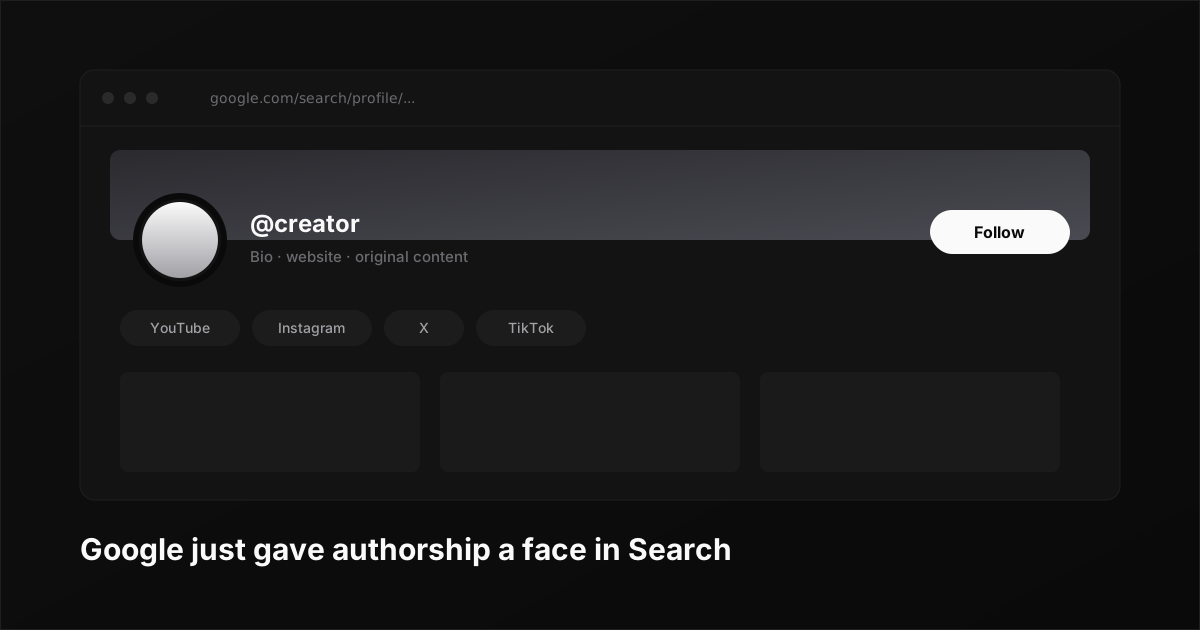
Google just launched Search Profiles: a dedicated, shareable space where publishers and creators get to shape how they appear in Search. Avatar, banner, bio, website link, social networks, videos, and recent content — all in one profile that audiences can follow, and that feeds Google Discover.
It looks like just another feature. It isn’t. It’s Google admitting, inside the product, something it had been dodging: in the era of AI-generated answers, the source matters more than the page.
What a Search Profile is
It’s a dedicated page inside Google that gathers a creator’s or publisher’s presence in one place. In practice, it pulls together:
- Visual identity — avatar, banner, handle, and bio.
- Links — the official website plus profiles on YouTube, Instagram, X, TikTok, and other video and social platforms.
- Recent content — the source’s newest articles, videos, and posts, collected on the profile.
- A follow button — followers start seeing that content more often in Discover, the feed on the home screen of the Google app.
You can reach a profile three ways: through the source’s content in Discover, through a new button on the Knowledge Panel in mobile Search, or through a direct URL — which effectively becomes your business card on Google.
Who gets one (for now)
The feature is rolling out in the U.S. first, with clear eligibility: a public profile with at least 100,000 followers on YouTube, Instagram, or X. For TikTok-only creators, the floor rises to 300,000. Google signaled it intends to expand to more creators and countries later, and to add more capabilities to the profile.
So it’s still a closed club. But the direction is what matters.
Why this happened now
It’s no coincidence. AI Overviews ate the click. An analysis by Seer Interactive found that when an AI Overview is present, organic click-through rate fell 61% between June 2024 and September 2025. Google is answering its own AI answer: if the page loses the click, the source needs another place to exist, be recognized, and be followed.
Search Profiles are that place. It’s Google rebuilding, on top of Search, a slice of the direct source-to-audience relationship that the AI Overview threatened to dissolve.
What this means for your strategy
Here’s the reading that matters for anyone working with content and brand: the game is moving away from keyword ranking and toward recognition of authorship.
For a long time SEO was about position: being first for a term. With AI answers, the question changes. It’s no longer “what position do I appear in?” but “do Google and the models recognize me as an original, trustworthy, attributable source?” The Search Profile is that recognition made concrete — an identity page that tells the system and the person, this is a real source.
And there’s a deeper reason holding the whole move together: in a world flooded with cheap, mass-generated content, genuinely original content is still only made by people. Human originality — an opinion with risk, first-hand data, lived experience — becomes the scarce differentiator. Google is investing precisely in being able to tell that origin apart and reward it.
What to do with it, even outside the U.S.
You don’t need to be in the rollout to act today:
- Consolidate your source identity. Coherent avatar, bio, and links across site and socials. When the profile arrives, whoever is already recognizable starts ahead.
- Make what the machine can’t. Proprietary data, a point of view, real experience. That’s what makes you quotable — in any engine, not just Google.
- Build an audience that follows, not one that passes through. Discover’s “follow” rewards a direct relationship with the reader. You build that before the feature exists.
What Search Profiles don’t solve is the broader brand question: how do I show up across all the AI engines — ChatGPT, Perplexity, Gemini, Grok — and not just Google? The profile owns Google’s turf. Measuring and building presence beyond it is the work that led us to build First Answer.
The takeaway
Search Profiles are small in reach today and huge in signal. Google is saying, loud and clear, that in the AI era the defensible asset isn’t the keyword — it’s being recognized as a source. Whoever gets that before the feature reaches their market arrives first.
Sources: A new profile to help publishers and creators highlight their work on Search — Google, June 2026. Context on the click drop-off: Google Launches ‘Search Profiles’ for Creators and Publishers — Variety.
Frequently asked questions
- What are Google Search Profiles?
- They're dedicated, shareable pages inside Google that gather a creator's or publisher's presence in one place — avatar, banner, bio, website link, social networks (YouTube, Instagram, X, TikTok), and recent content. Audiences can follow the profile and start seeing that content more often in Google Discover.
- Who is eligible for a Search Profile?
- At launch, the feature is available only in the U.S. and requires a public profile with at least 100,000 followers on YouTube, Instagram, or X. For TikTok-only creators, the minimum is 300,000 followers. Google signaled it plans to expand to more creators and countries later.
- How do you access a Search Profile?
- Three ways: through the source's content in Discover, through a new button on the Knowledge Panel in mobile Search, or through a direct URL that works as the source's business card on Google.
- Do Search Profiles replace traditional SEO?
- No. They signal a shift in emphasis: from keyword ranking to recognition of authorship. Producing original, well-structured content still matters, but the defensible asset becomes being recognized by Google and the models as an original, trustworthy, attributable source.
- Do Search Profiles help you show up in ChatGPT, Perplexity, or Gemini?
- Not directly. The profile covers Google's turf (Search and Discover). To measure and build presence in ChatGPT, Perplexity, Gemini, and Grok you need a dedicated GEO strategy beyond Google — which is what First Answer does.