One brand, seven AIs: 91% of cited sources show up in a single model
A mini-study of 5,029 answers from seven AI models to 30 shopping questions in Brazil: almost no page is cited by all of them, and only Google's models share sources with each other.
Part of the topic How AIs choose sources →
Almost no page gets cited by every AI. In a mini-study of 5,029 answers from seven models to 30 Black Friday shopping questions in Brazil, 91.4% of the pages cited by ChatGPT, Perplexity and AI Overviews for the same question appeared in only one of the three. That is practically the number Kevin Indig found in May 2026 across 20,000 prompts in Europe: 91.07%.
In practice, being a source in one model says little about being a source in another. The partial exception is Google’s models, which share some sources with each other. The data comes from First Answer’s monitoring; I’m its co-founder and CTO.
How the mini-study was done
- Questions: 30 shopping questions in Portuguese, written for the study and unrelated to any client. Examples: “Where can I buy a TV on Black Friday at a good price?” and “Which online stores are trustworthy for Black Friday shopping?”.
- Models: ChatGPT, Gemini, Perplexity, Grok, Copilot, Google AI Overviews and Google AI Mode.
- Period and volume: each question ran once a day in each model, from October 20 to November 12, 2026, for a total of 5,029 answers, about 720 per model.
- What was counted: the pages cited in each answer, normalized (no tracking parameters, no “www”, YouTube videos by ID). Google’s internal links, such as search and Shopping product pages, were left out: 694 of 59,824 citations (1.2%).
- The measure: for each question, I pooled the pages each model cited over the 24 days and counted how many models cited each page. It follows the logic of Indig’s study, which compares engines within the same prompt.
91% of pages show up in a single model
With the same three models as Indig’s study, the Brazilian result landed right next to the European one:
| This mini-study (Brazil) | Kevin Indig (Europe) | |
|---|---|---|
| Pages cited by a single model | 91.4% | 91.07% |
| Pages cited by all three | 1.3% | 2.37% |
Indig’s sample is different (20,000 prompts, weighted toward Spain, and he asks for the numbers to be read as directional), but the order of magnitude held.
Across all seven models, 91.2% of pages were cited by a single model and 0.09% by all of them. That figure is skewed: Grok cited 43 different pages per answer on average, against 3 to 11 for the others, which inflates the count of exclusive pages. Leaving Grok out, across the other six, 77.4% of pages show up in a single model and 0.35% in all of them.
The result doesn’t come from the long tail of one-off citations either. Counting only pages a model cites in at least a quarter of its answers to a question, the recurring sources, 79% to 92% remain exclusive to one model, depending on the cut. At the domain level, overlap grows a little, but most domains stay exclusive: across the three models in Indig’s cut, 80.7% of cited domains show up in only one.
Only Google forms a bloc
Comparing the models in pairs, the share of pages in common for the same question shows a clear pattern.
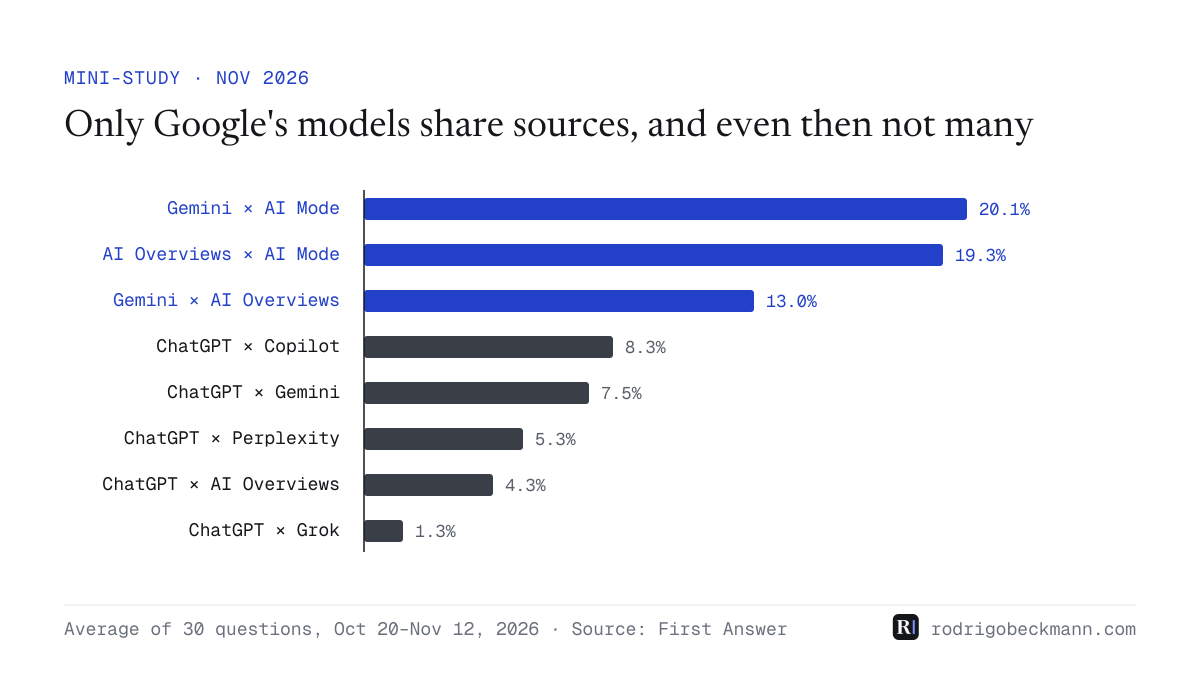
- Google’s models resemble each other. Gemini and AI Mode share 20.1% of their pages; AI Overviews and AI Mode, 19.3%; Gemini and AI Overviews, 13.0%. That is the highest overlap in the study, and still four in five pages differ.
- Outside Google, pairs stay below 9%. The closest is ChatGPT and Copilot, at 8.3%. ChatGPT and AI Overviews share only 4.3% of their pages.
- Grok cites a different web. With any other model, the overlap stays between 1.3% and 2.2%.
The data doesn’t say why some pairs look alike: the mini-study measures the outcome, not the mechanism.
Not every answer cites sources
The share of answers with no citation at all also varies by model: 25.7% for AI Mode, 13.9% for Copilot, 10.6% for Gemini, 6.9% for ChatGPT, 2.6% for Grok, and 0% for Perplexity and AI Overviews. Anyone measuring presence through citations needs to know this: in a model that cites little, there are fewer places for a brand to show up.
What this changes for a brand
- Measure each model separately. A good result in ChatGPT says almost nothing about AI Overviews. An average “AI visibility” score hides exactly that difference. The measurement guide shows how to build the sample.
- Treat Google as a bloc, but not as one model. Gemini, AI Overviews and AI Mode share some sources, and that’s where a well-placed page has the best chance of showing up in more than one place. Even there, most sources differ.
- Diversify where the brand gets cited. If each model searches in different places, presence on a handful of pages covers a handful of models. The guide to how AIs choose sources explains why what third parties publish about a brand weighs so much.
What the mini-study doesn’t show
- One topic. Black Friday shopping questions, at a time with heavy news coverage of deals. In another sector, overlap could be higher or lower.
- Sources, not brands. The study measures cited pages, not the stores or brands recommended. Two models can recommend the same store while citing different pages.
- Pooled over 24 days. Each model’s pages were pooled over the period. Answer by answer, the numbers would be different, because each answer cites only part of the sources a model uses over time.
- Collection environment. Answers come from automated collection, which can differ from what each person sees with their own account, history and location.
Showing up in one AI isn’t showing up “in AI”. There are seven different source lists, and a brand needs to be on more than one of them.
Frequently asked questions
If my brand is cited in ChatGPT, will it also show up in Gemini?
Not necessarily. In a mini-study of 30 shopping questions in Brazil, from October and November 2026, ChatGPT and Gemini had on average 7.5% of their cited pages in common for the same question. Being a source in one model says little about being a source in the other, so each one needs to be measured.
Which AI models cite the same sources?
Google's models are the most alike: in the same mini-study, Gemini and AI Mode had 20.1% of cited pages in common, AI Overviews and AI Mode 19.3%, and Gemini and AI Overviews 13.0%. Outside Google, no pair went above 8.3%, and Grok stayed between 1.3% and 2.2% with any other model.
How many sources does each AI cite per answer?
It varies a lot. In answers to Black Friday shopping questions, Grok cited on average 43 different pages per answer, AI Overviews 10.6, Perplexity 10.1 and ChatGPT 3.3. AI Mode answered with no citation at all 25.7% of the time, and Copilot 13.9%.
Why do AI models cite such different sources for the same question?
Each model runs its own searches, on its own indexes and criteria, and picks which pages to use in the answer. Google, for example, says AI Overviews and AI Mode may issue several related searches for a single question. With different processes, the source lists come out different.
Sources
- The Consensus Gap — Growth Memo (Kevin Indig), 11 May 2026 · primary source
- AI features and your website — Google Search Central, 10 Dec 2025
